This sermon was preached at Lord of Life Lutheran Church in Darien on Pride Sunday before they voted to officially become a Reconciling in Christ (RIC) Congregation.
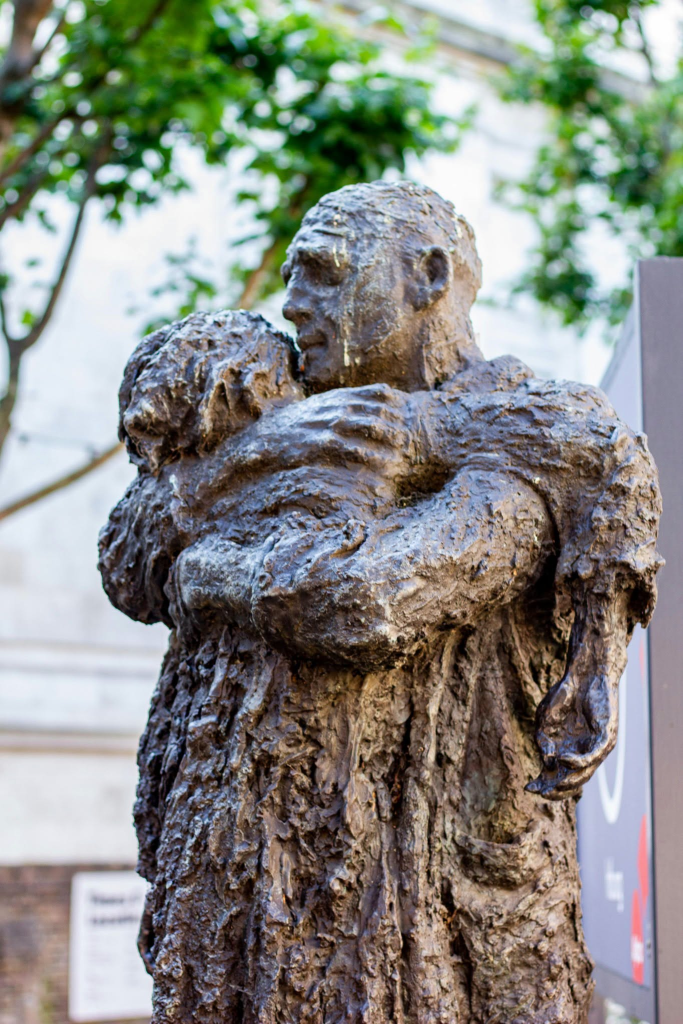
The story often called “The Prodigal Son” is familiar to many of us.
The younger son of a wealthy man demands their inheritance, leaves home, squanders everything, and eventually comes crawling back, hoping to be accepted as a servant. Instead, they are welcomed home by their father with open arms. A feast is prepared. A celebration begins.
One of my favorite interpretations of this story comes from a beloved prophet and ancestor in our Lutheran tradition named Joel Workin.
Joel was one of the first openly gay Lutheran candidates for ordained ministry. In 1987, he publicly came out while seeking ordination. In response, the church revoked his certification and refused to place him on the roster of approved candidates waiting for call.
Joel’s ministry continued anyway. He served at the AIDS Healthcare Foundation and as Director of Chris Brownlie Hospice. He and his partner, Paul Jenkins, organized for the full inclusion of LGBTQIA+ people in the church. Both men eventually died of AIDS.
Joel was also a writer.
In an essay entitled Overflowing, Joel reflects on this story from Luke 15. He places the emphasis not on the prodigal child, but on the patient Parent.
And then he goes even further.
Joel reminds us that God does not simply wait for us to come home.
God goes searching for us.
God pursues us.
God comes looking.
In our wanderings, God does not simply say, “Come home.”
Home comes to us.
I have always loved that image.
Home comes to us.
Because sometimes we are too lost to find our way back on our own.
Sometimes we don’t even realize we have wandered.
For much of my life, I was taught that LGBTQIA+ people were the prodigal children.
Lost.
Confused.
Wayward.
People who needed to repent.
People who needed to return.
People who needed to come home.
But looking at the history of the church, I wonder if we have gotten the story backwards.
I grew up in an ELCA congregation.
I was baptized Lutheran. That ELCA congregation is the church where I was confirmed. Raised.
In the summer of 2009, while I was away at college, my home congregation voted to leave the ELCA after the churchwide assembly opened the door for LGBTQIA+ people to serve in rostered ministry.
Around that same time, I was beginning to come out as bisexual.
First to myself.
Then to a few trusted friends.
Then to people I loved.
I wasn’t even publicly out at church.
But I pushed back against the decision. I asked questions. I wanted conversations.
Eventually my pastor sat me down and said, “Maybe you would be more comfortable, and we would be more comfortable, if you went somewhere else.”
I was absolutely crushed.
Not only because I was losing my church home.
But because I was learning a lesson that many LGBTQIA+ people know all too well.
Sometimes simply asking whether everyone belongs is enough to make people uncomfortable.
Sometimes even supporting queer people is treated as a threat.
For years I prayed some version of the same prayer:
“God, please change me or change the church.”
And God’s answer, over and over again to my prayer to become straight, was:
“No.
I will not change you.
Period.
I created you on purpose.
Your queerness is not a liability.
It is not an obstacle.
It is not something to overcome.
It is a gift.”
The more I have reflected on that experience, and the more I have reflected on Joel’s witness, the more I have come to believe that LGBTQIA+ people are not best understood as the prodigal child in this story.
It is not us who have strayed by being who we are.
Often, its the institution of the church that has lost its way.
Instead of gallivanting in some exotic land and spending lavishly on wine, wo/men, and song, the church has become less differentiated from Empire; less queer, more comfortable.
Instead of wandering into some distant country, the church has wandered into respectability.
Into nationalism.
Into white supremacy.
Into cis-hetero patriarchy.
Into the pursuit of power.
Into the belief that safety matters more than solidarity.
The church has strayed because it has become comfortable with the very things God calls us to resist.
And yet God, in Her graciousness, has not waited patiently by the mailbox for the church’s return.
God has relentlessly pursued Her people.
In every generation God raises up prophets to call us home.
People who don’t fit neatly into the categories society creates.
People who are different.
Queer.
Again and again, LGBTQIA+ people have been among those prophets.
We know what it means to be told “no” when God is saying “yes.”
We know what it means to survive.
We know how to hold each other tight, how to build community when institutions abandon us.
Our queerness is subversive.
It asks questions.
It pushes back.
We are resilient.
We have survived, held on, become stronger.
We are playful.
Despite suffering, we have built cultures and communities full of joy.
We are campy.
Glittery.
Full of life in a world that has too often proclaimed death over us.
When the world has tried to say “no” to us, when the church has echoed that “no,” we have said “yes.”
We say yes to ourselves.
And in doing that, we say yes to the image of God inside of us.
So when I look at the history of the church, I do not see LGBTQIA+ people endlessly running away from God.
I see LGBTQIA+ people pursuing a wayward church.
I see queer Christians continuing to show up.
We keep showing up.
We keep serving.
We keep loving the church.
Even when the church has not always loved us back.
Again and again, LGBTQIA+ people have stood with arms open, beckoning the church back toward its original mission of love and liberation for all people.
Not that we needed the church’s approval or because we were trying to earn our place. But because we loved the church. And we believed the Gospel was bigger than the church’s fear. We believed in the church. And we patiently waited and tirelessly worked to help the church live into its promises.
In that sense, queer people have often reflected the image of the patient Parent.
Calling the church home.
And I want to say something directly to my LGBTQIA+ family in this room:
To those of us who have spent years wondering whether there would ever be a place for us in the church.
To those of us who learned to brace ourselves every time the church started talking about people like us.
Our presence in the church is not charity. It is not a compromise. It is not a concession.
The church is not doing us a favor by making room for us.
We are not a problem to solve or an obstacle to overcome.
We are not a constituency to accommodate.
We are not an exception to be tolerated.
We are beloved children of God, fearfully and wonderfully made.
God centers the marginalized. Throughout scripture, the people pushed to the edges become the very people through whom God transforms the community.
When LGBTQIA+ people are affirmed, celebrated, and centered, its not only good for those of us who are queer. It is good for the church.
The whole church becomes more fully itself.
Our gifts matter.
Our relationships matter.
Our leadership matters.
Our stories matter.
Our callings matter.
Not because a congregation blesses our identities.
Because God already has.
Today, many of us will cast a vote [about whether to become RIC- officially affirming of LGBTQIA+ people and committed to anti-racism].*
If I’m honest, I don’t think this vote is really about whether LGBTQIA+ people are welcome here.
Looking around this room, I think that question has already been answered.
It has been answered in relationships, in ministry, in friendship, in community.
LGBTQIA+ people have been here: praying, serving, singing, teaching, loving, leading, offering our gifts.
Long before any vote, God had already spoken.
“You are fearfully and wonderfully made.”
Long before there was a vote, God had already spoken.
“There is no longer Jew or Greek, slave or free, male and female; for all are one in Christ Jesus.”
Long before there was a vote, God had already spoken.
And long before there was a vote, countless LGBTQIA+ people had already answered.
“Yes.”
Maybe what happens today is this church’s way of saying out loud, boldly, and in public what God has been saying all along.
“Yes.”
Amen

